
Cast Out by Blood: A Call to Justice for LGBTQ+ People Rejected by Family
This blog post is written in honor of someone deeply important to me, who will remain anonymous for their safety and privacy. What I witnessed was not just prejudice — it was a brutal and heartbreaking rejection of their identity by family. The pain of that moment echoes in countless LGBTQ+ lives across the United States and Latin America.
The Human Cost of Rejection
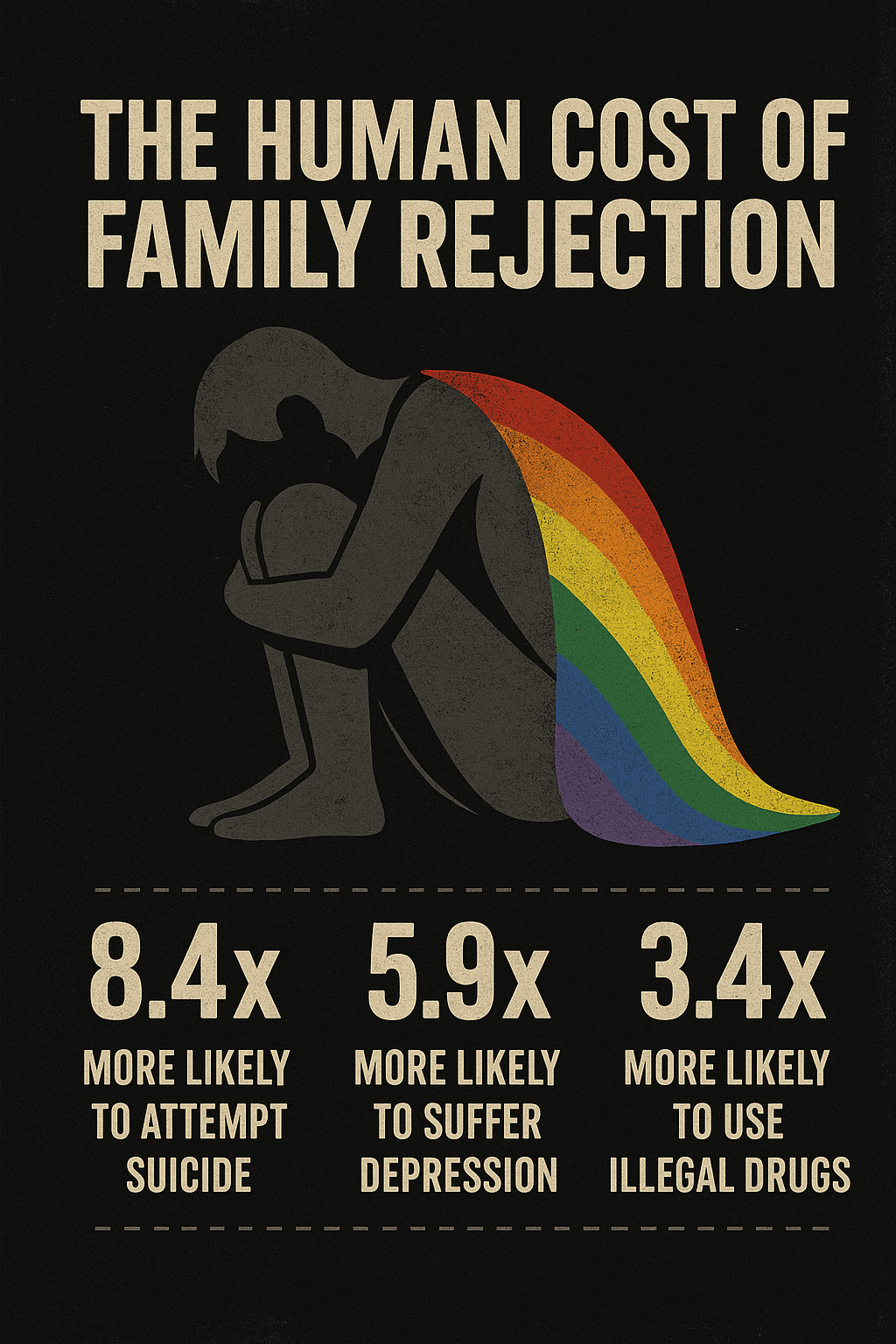
Family should be the place where we are safest, yet for many LGBTQ+ people, it becomes the first place they experience betrayal. According to the Family Acceptance Project, lesbian, gay, and bisexual youth who experience high levels of family rejection are 8.4 times more likely to attempt suicide, 5.9 times more likely to suffer depression, and 3.4 times more likely to use illegal drugs compared to peers who are accepted (Ryan et al., 2009).
“This study clearly shows the tremendous harm of family rejection, even if parents think they are well-intentioned.”
– Dr. Caitlin Ryan, Family Acceptance Project
These aren’t just numbers. They’re the reality of lives upended. Mental health declines steeply when love is replaced by judgment. LGBTQ youth who feel rejected by family are far more likely to experience anxiety, PTSD, self-harm, and even homelessness. The Trevor Project found that 45% of LGBTQ youth in the U.S. seriously considered suicide in the past year alone (The Trevor Project, 2023).
Cultural and Religious Influences in the U.S. and Latin America
In the U.S., family rejection is often tied to conservative religious beliefs. Many households interpret LGBTQ identity as sinful, and youth are told they are broken or in need of fixing. Despite the American Psychological Association denouncing all forms of “conversion therapy,” it remains a tragically common reaction from religious families.
In Latin America, the dynamics are intensified by a cultural blend of machismo, Catholicism, and a strong emphasis on family honor (Peña-Talamantes, 2013). Here, LGBTQ children are often seen as threats to family reputation. Phrases like “not under my roof” or “what will the neighbors say” reinforce the idea that love is conditional.
A study spanning six Latin American countries found that 34% of adolescents believed homosexuality was a mental illness, showing the deeply entrenched stigma (PAHO, 2021). In more extreme cases, LGBTQ youth are sent to underground clinics for “treatment” or subjected to religious rituals to “cleanse” them.
Intersectional Realities
For Hispanic and Latinx LGBTQ individuals in the U.S., cultural and religious pressures collide. According to a Center for American Progress report, 46% of Hispanic LGBTQ Americans reported discrimination, compared to 31% of white LGBTQ individuals.
“Acceptance from even one adult can significantly reduce suicide risk for LGBTQ youth.”
– The Trevor Project
Faith vs. Love: It Shouldn’t Be a Choice
Many families justify their rejection with religious beliefs — but love is not contradictory to faith. Even Pope Francis has stated:
“Never condemn your children. Accompany them.”
– Pope Francis, 2022
No religious or cultural belief should ever justify making a child feel worthless. True faith uplifts; it does not cast out.
The Road Forward: A Call to Justice
Rejection from family is not just a personal tragedy. It is a public health crisis. These young people deserve better. As a society, we must call out this injustice wherever it hides — whether it’s in a church sermon, a family dinner, or a parent’s silence. Acceptance saves lives. Condemnation takes them.
We must support safe housing, therapy, chosen family structures, affirming communities, and accessible mental health care for those exiled. We must educate families — especially in faith-based and immigrant communities — about the psychological harm of rejection.
And most of all, we must say this loudly: We see you. You matter. You are worthy of love and belonging — exactly as you are.
Sources
- Ryan, C., et al. (2009). Family Rejection as a Predictor of Negative Health Outcomes in White and Latino LGB Young Adults. Pediatrics.
- The Trevor Project (2023). National Survey on LGBTQ Youth Mental Health.
- Peña-Talamantes, A. E. (2013). Understanding Latina/o Cultural Values and the Coming-Out Process.
- PAHO (2021). Adolescent Health Survey in Latin America.
 Tony Gebhard